

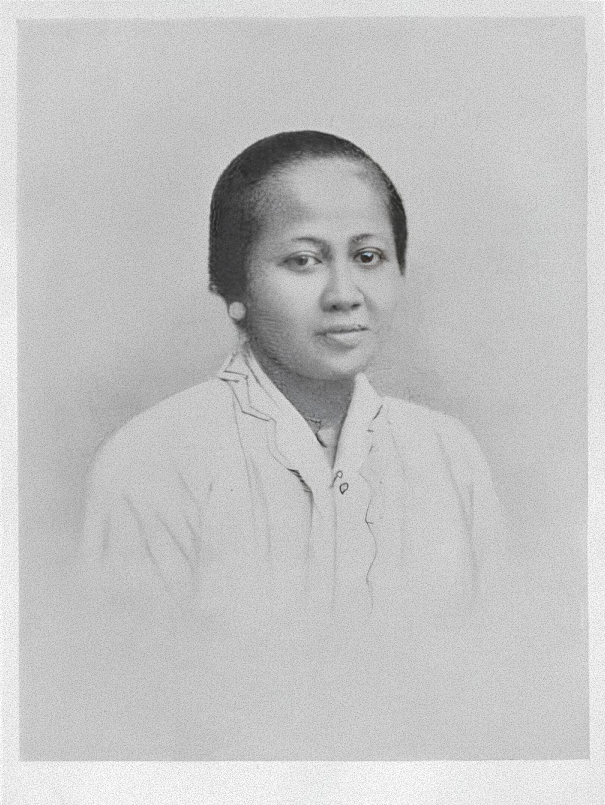
Raden Ajeng Kartini, The pioneer of women's rights in Indonesia.
“The most important thing for women is to be able to think for themselves and to have the courage to speak out.”
Raden Ajeng Kartini, born in April 21, 1879, in Jepara, Central Java, she came from a Javanese noble family that granted her basic education at Dutch School, the ELS (Europeesche Lagere School) in her childhood. Yet, during her adolescence she was confined at home due to the Javanese custom every woman faced in her generations. But, even in this unfortunate situation, she still continued to study independently and maintained friendship with her friends in the Netherlands. The friendships she had later became a way for her to actually preserve and to voice her thoughts on the importance of education for women of Indonesia, equal rights, and criticism of the oppressive feudal and colonial systems. The letters she sent later were compiled and published in a book called “Habis Gelap Terbitlah Terang” (“Out of Darkness Comes Light”).
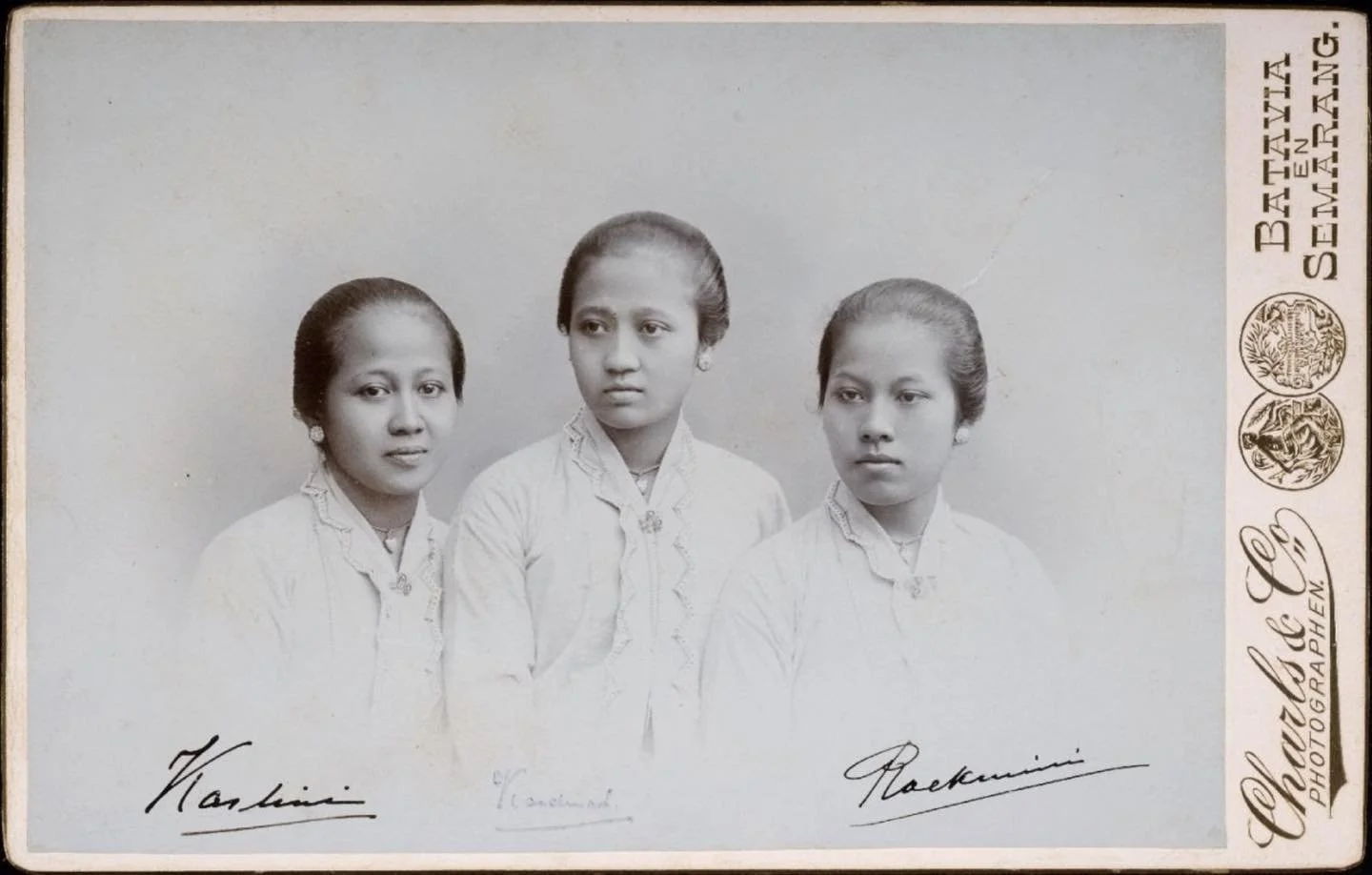
Kartini (left) and her sisters Kardinah and Roekmini, 1902. Photo no. 15467, courtesy of kitlv, Leiden.
In her adolescence, she has been longing to be able to study abroad, to enrich her knowledge abroad, and to see the other side of the world. From many of her letters, this one she wrote to Stella Zeehandelaar on May 25th 1899 tells of her hopes and dreams to fly abroad but also living as Javanese women in the 18s.
“If the laws of my land permitted it, there is nothing that I had rather do than to give myself wholly to the working and striving of the new woman in Europe, but age-long traditions that cannot be broken hold us fast cloistered in their unyielding arms. Some day those arms will loosen and let us go, but that time lies as yet far from us, infinitely far. It will come, that I know; it may be three or four generations after us. Oh, you do not know what it is to love this young, this new age with heart and soul, and yet to be bound hand and foot, chained by all the laws, customs, and conventions of one’s land. All our institutions are directly opposed to the progress for which I so long for the sake of our people. Day and night I wonder by what means our ancient traditions could be overcome.”
“We girls, chained as we still are to the old practices and customs, were only able to benefit slightly from this progress as regards education. It had already been a great offence against the morals and customs of my country for us girls to go out and be educated and therefore we had to go out of our house every day to attend school. You see, the adat of our country strongly forbids young girls to go outside their home. We were not allowed to go anywhere else and the only educational institution with which our little town is blessed is just an ordinary public elementary school for Europeans.”
“Have I the right to break the hearts of those who had given me nothing but love and kindness my whole life long, and who have surrounded me with the tenderest care?”
– R.A. Kartini, 25th May 1899
This letter specifically shows her internal conflicts between her wants and what she’s accustomed to do. She has been kept home, she was locked up and given no ability to communicate with the outside world, just because she’s a woman. After she turned 16 she can only “officially” get her freedom, being able to see the outside world again but still has to follow very strict unspoken rules that every woman follows in Javanese household. She questions the arranged marriage that was given to her since birth. Later, she must marry someone since not to marry at that time was the greatest sin that moslem woman can commit. But, even marriage isn’t as safe as it sounds, because most men were having polygamy in this era, which Kartini finds as a gruesome injustice. But in the end, she still has to obey the customs to not break the heart of those she loved. Even in these unfortunate conditions, she still kept her desire to break off the traditions, where she wished she could continue her education, and to share it to every woman in Indonesia.
The freedom she wished for women in Indonesia came through layers. She voiced how she wished that women in Indonesia could also learn as much as the men do, get as much knowledge and be able to go abroad to focus on their interests. Freedom from restrictive traditions, she still sees the traditions as valuable and it teaches a lot in life, but it is also limiting.
“to be free, independent, emancipated and as midwives we can make ourselves so useful.”
– R.A. Kartini, 31 January 1901
Today, the fights and the voice of R.A. Kartini is still remembered and celebrated. On 21st April (Kartini’s birthday) is celebrated as “Hari Kartini” where every year, children wear kebaya & traditional attire to school, some also hold fashion shows for the kebaya they use, speeches about women empowerment and performances. This shows that Kartini is seen as a cultural icon that sparks femininity, grace and national pride. Indonesia also celebrated her in other ways, there are streets named after Kartini across cities, statues & monuments, there is also a museum of R.A. Kartini, and her face is on older Indonesian banknotes.
So, do we still live with her inside conflict and questions? Well, the answer is yes but it looks different now. The conflicts she faced in the past are still very harsh and limiting for women but now that conflict evolved, it changed from “Can I leave the house?” but rather “Can I choose a career over marriage without judgement?”. But there are said cities (bigger cities) that provide freedom for women. If you go to smaller cities, the picture shifts, the hardships they need to go through just to access education, and healthcare still varies widely depending on class (economical), region, and local norms. Although, we hope that each generation could answer her questions and her conflicts entirely in the future. Happy R.A. Kartini day.