

Gereja Ganjuran: The unique acculturation that happened in Yogyakarta.
Catholicism, like other religions, came to Indonesia like the others, it was carried by traders and missionaries who came to Indonesia. They used the advantage of this country, the maritime trading route, to spread a lot of religions like Hinduism, Buddhism, Islam, Confucian and Christianity. The spreading of religions by traders was one of the fastest methods to spread religions at that time, and not too long after that a lot evolved.
Meanwhile, Catholicism first started in Indonesia around the 14th century. The initial mission brought from Catholic teachings was led by a Franciscan friar, Matthewsi, from Italy. The friar visited multiple areas in Indonesia like Sumatra, Banjarmasin, and Java around 1318-1330. At the time, Indonesia was conquered by the Majapahit Empire and most of the people in Indonesia were either following Hinduism teachings or Buddhism. The friar was sent by the pope, who was the leader of the Catholic Church at that time, to carry out a mission to the interior of Asia. The mission was called “pioneer mission” where he had to give every detail and information about conditions in Asia.
The real start was around the 16th century where Catholicism started and brought by the Portuguese that were trying to get spices. The arrival of Portuguese to Indonesia actually caused the religion to evolve, to spread more since there are a lot of missionaries that came too. In 1605 VOC (Vereenigde OostIndische Compagnie) the dutch’s company at that time slowly dominated a lot of areas, and life for many catholics at that time was sadly executed or forced to change their religions to christianity. Until 1808 which is around 200 years after that unfortunate event, under the leadership of Governor General Herman Willem Daendels, granted freedom to the catholic believer. But in 1848, there were only 4 Catholic church centers in the Indonesian region.
Later in 1896, a pastor was sent to Indonesia to spread the catholic beliefs focusing in Java, he was Pastor Fransiscus Georgius Josephus van Lith, who was nicknamed the Missionary of the Land of Java, came to the Catholic mission center in Muntilan, Central Java and people start to call him Pastor van Lith. He started to build schools for teachers called Normaalschool in Muntilan in 1900 and Kweekschool in 1904 in line with the Ethical Politics/Reciprocity of the Dutch colonialists. Then everything developed, various Catholic schools were built and gathered in a Catholic educational foundation known as Yayasan Kanisius (the Kanisius Foundation). This event strongly supports the development of Catholics in Java, as the Catholic population increases, many churches are being built along with the growth of the community.
Around this time, nearly all Catholic church buildings in Javanese cities were constructed in European/colonial or Indies architectural styles. The same applies to schools and seminaries, offices, and residential areas. In 1980-1990 awareness of identity emerged so that in general local and regional architectural styles began to be applied. Hence, reconstructions of these churches changed the style of churches. In 1970-2006 there were a lot of requests to expand Gereja HKTY Ganjuran (Ganjuran Church) since it was built in 1924 it was rather small. In 2006 a bad earthquake happened in Yogyakarta and demolished buildings, and unfortunately the Gereja HKTY Ganjuran was no exception.
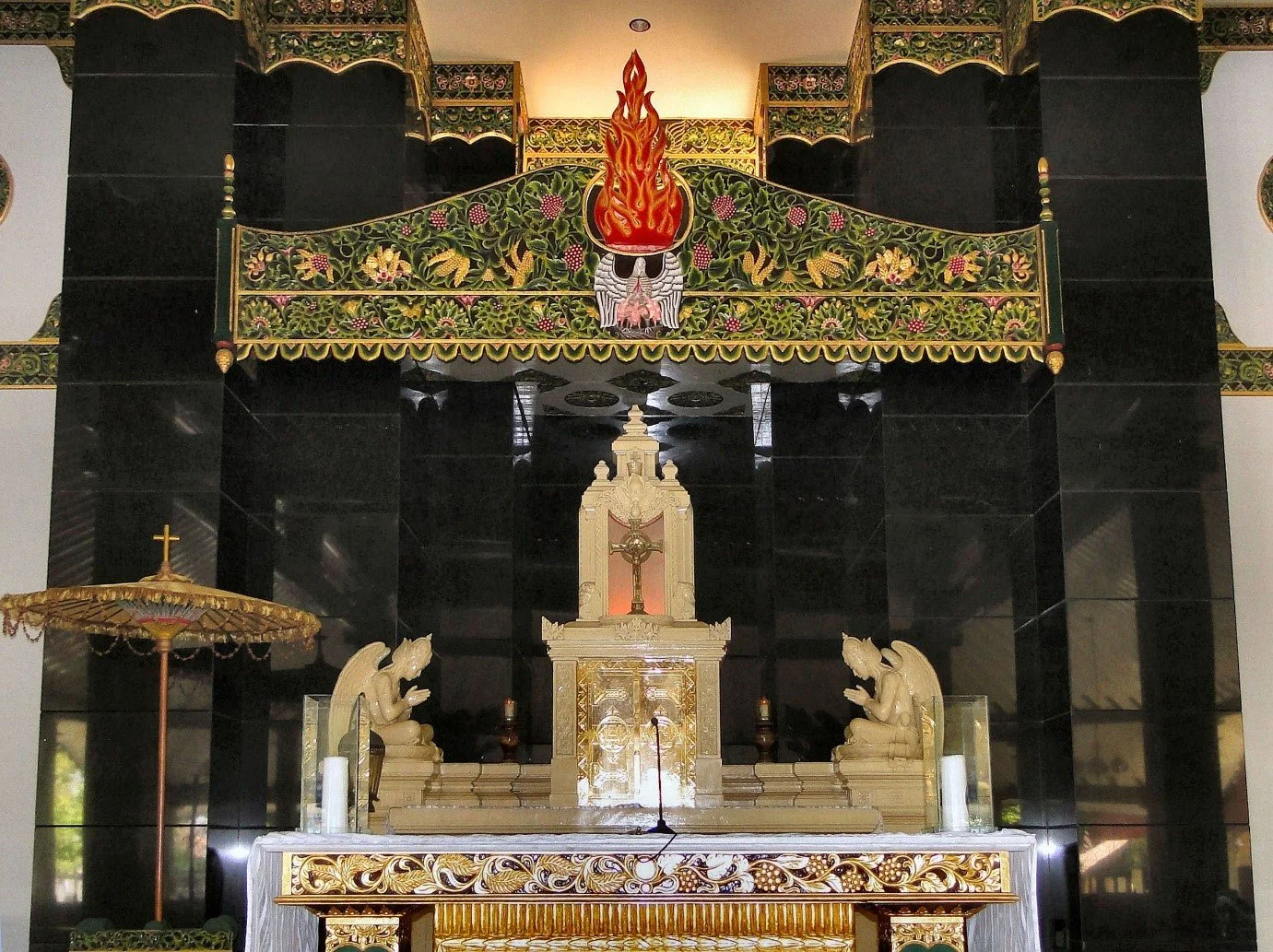
Later, they rebuilt the church a little differently. Acculturation is a combination of foreign culture with local culture so it is easier for people to accept since it didn’t fully change their whole culture on its own. This is already happening in the architecture of Catholics Churches. After the unfortunate earthquake, Gereja Ganjuran consulted the Yogyakarta Cultural Heritage Service regarding the reconstruction of the church, retraced to its history they found Schmutzer writings, he initially wanted to build the church with javanese style architecture, with Joglo and later adapted to tajug. This then allowed the reconstruction of the church with Javanese style, styling the whole entirety of the church itself to be javanese centered, but the Statue of the Sacred Heart of Jesus is mandatory to be kept in its original place.
The Javanese house style is divided into two: Dalem and pelataran. Dalem (omah jero) is more private and intimate while also considered a sacred place of the house, and there is the pelataran which is a public place to connect with the neighbors and others. There is a connecting part of the house called pringgitan that’s used as an intermediate living room or reception area for receiving guests. A spatial planning pattern with high cultural value in Javanese tradition. The connection between these settlement traditions is formed in a cultural form and passed down from generation to generation.The architectural acculturation of Javanese houses into Catholic churches can be seen in the structure, spatial layout, and ornamentation. As a Catholic church, it serves as a physical "vessel" for God's presence. As a spatial concept, the Imam's Panti (with the central altar) is the most sacred area because it is where the Eucharistic celebration takes place, and the Ummat Panti serves as the worship area, oriented toward the Imam's Panti.
In terms of how some parts of Javanese house is used opposed to how it’s used in the Ganjuran Church would be:
Pendapa: is often used as an area to welcome guests, meeting some relatives, discussing or just to chat with the whole family, meanwhile in Ganjuran Church, the pendapa is used as the main building.
Pringgitan: is often used as an area to have sacred ceremonies in Javanese houses, while it is used as an area for Priest's House and Altar in Ganjuran Church.
Omah jero/Dalem: is a part of the house that act as the main building of the house which is very private and is used for the family only, while there’s no omah jero/dalem in Ganjuran Church.
Gandok, is an area that’s used as the main living place in javanese house, but it is used as a sacristy and kosher quarters in Ganjuran Church.
In the end, Gereja Ganjuran is more than just a place of worship, it is a quiet combination between faith and culture. The presence of a Javanese Jesus, the joglo-inspired structures, and the deeply rooted spatial philosophy all show that religion does not always arrive as something that replaces, but something that adapts, listens, and grows with the people. What happened in Ganjuran reminds us that belief can take many forms, and sometimes, the most powerful way for it to be understood is when it speaks the language of the land it enters. Here, faith doesn’t feel distant or foreign, it feels familiar. It feels like home.